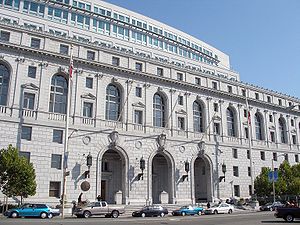
- Image via Wikipedia

The Supreme Court denied review today in Burlage v. Superior Court, leaving intact the decision that, by speculation of some (including yours truly), will increase the number of legal challenges to arbitration decisions. I won’t go so far as to say that it will “open the floodgates,” but it certainly opens an avenue to judicial review that many would not have tried before the decision was published.
Expect to see many challenges that assert, though not in so many words, that the legal error that occurred in their case is grounds for vacating an award if the error led the arbitrator to exclude evidence. The challenge for these litigants will be to squeeze the history of their arbitration proceedings into the confines of Burlage, and its interpretation of Code of Civil Procedure section 1286.2, subdivision (a)(5). There will be plenty of fights over what those confines are.
The section headed “Uncertainty and a Little History” at the outset of Justice Gilbert’s opinion in Burlage certainly seemed to tee the case up for Supreme Court review:
We look to legal precedent in deciding cases. We believe the law is predictable and provides litigants and counsel a reasonable degree of certainty. True, but not always.
In 1991, we wrote what we thought was a routine arbitration opinion. (Moncharsh v. Heily & Blase (Apr. 2, 1991, B048936) [nonpub. opn.].) We relied on decades of precedent in our unpublished decision to affirm the arbitration award because no error appeared on the face of the award. In dicta, we noted that had the error appeared on the face of the award and created substantial prejudice, we would have reversed.
To our surprise, our Supreme Court granted review. Our holding was affirmed, but our dicta “reversed.” (Moncharsh v. Heily & Blase (1992) 3 Cal.4th 1.) Oh well, nobody’s perfect. Moncharsh held that judicial review of an arbitrator’s decision regarding questions of fact or law is extremely limited. Thus, even though an error of law appears on the face of an arbitration award and causes substantial injustice, it is not subject to judicial review in the absence of a limiting clause or as provided by statute. (Id. at p. 25.)
For the next decade, courts have wrestled with the question of when and under what circumstances judicial review of an arbitration award is proper.
Though we have no Supreme Court review this time, we’re about to witness another round of wrestling. As more and more courts consider the question, significant judicial discord may develop, and Justices Baxter and Corrigan — the two justices who were in favor of review — might sway their colleagues to grant review in a similar case.
![Reblog this post [with Zemanta]](http://img.zemanta.com/reblog_e.png?x-id=d89b8c85-aa3a-4919-9ec9-1374a53b427d)
One Comment
Pingback: